“I felt disgusted”: Ukrainian chess champion on FIDE welcoming Russia back while missiles still fall

(function(w,q){w[q]=w[q]||[];w[q].push([“_mgc.load”])})(window,”_mgq”);
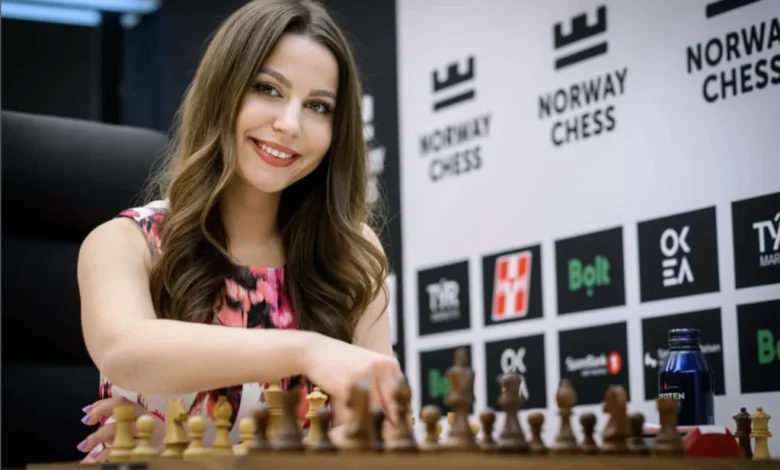
When Ukrainian chess player, streamer, and commentator Angelika Valkova saw the news that FIDE had voted to restore Russian national symbols in competition, her reaction was visceral.
“I was feeling disgusted and it was a true shame what happened because I didn’t hear that the war stopped,” Valkova told Euromaidan Press. “I didn’t hear that Russian troops left Ukraine and stopped killing civilians, that there are no missiles anymore targeting Ukraine.”
The International Chess Federation voted on 14 December to allow Russian and Belarusian teams back into official competitions—a decision praised by Kremlin spokesman Dmitry Peskov, who also serves as chairman of the Russian Chess Federation’s Board of Trustees. “We believe that it was the right step towards the depoliticization of sports,” Peskov told TASS.
The vote came just three days after the IOC Olympic Summit explicitly recommended that existing sanctions “should remain in place for senior competitions.”
A disputed vote chaired by Putin’s former deputy
The online General Assembly voted on two separate resolutions—one from Russia demanding full restoration of national symbols, another from the FIDE Council proposing a more moderate approach. In a procedural outcome Western federations have called illegitimate, delegates passed both contradictory resolutions. Neither secured a majority of the 141 registered delegates.
Under FIDE’s interpretation, Russian and Belarusian teams are now admitted to official tournaments, with full national symbols allowed in youth competitions and restrictions on hosting events in Belarus lifted.
“It was supposed to be an open vote. And they did it a secret vote so the federations who are voting for it would not be called out,” Valkova said. “This is also against FIDE statutes and laws.”
FIDE President Arkady Dvorkovich—a former Russian Deputy Prime Minister whose “long-standing” connection to Putin was noted by FIDE’s own Ethics Commission—chaired the meeting. In June 2024, the Ethics Commission ruled to suspend the Russian Chess Federation for two years for incorporating chess clubs from occupied Ukrainian territories into its structure—a decision later overturned on appeal to a €45,000 fine.
The English Chess Federation accused Dvorkovich of acting “as a tool of the Russian state” and refusing to allow debate on the ECF’s own motion.
Norwegian Chess Federation president Lasse Østebø Løvik called the proceedings “tragicomic,” saying Western input “fell on deaf ears and empty heads,” he told Chess.com.
During the General Assembly debate, Ukrainian Chess Federation president Oleksandr Kamyshin addressed the delegates directly: “It is surprising to hear how some people call an unprovoked, full-scale invasion a geopolitical issue.”
He urged delegates to maintain sanctions, noting that only five out of 108 international sports federations currently allow Russian team participation. “Allowing this would send a deeply troubling political signal and compromise the moral integrity of FIDE.”
What sitting across from Russian players actually means
Valkova, who has played professionally in Germany since 2016, described what happens when Ukrainian players face Russians in tournament settings.
“When something like this happens on the top level, what usually players are doing is they’re not shaking hands,” she said. “We have very famous sisters Muzychuk—Mariya Muzychuk used to be women’s world champion. They are not shaking hands with Russian chess players. If they have to play, they play, and at the end of the game, again, they are not shaking hands.”

She recalled an incident at the German Women’s Team Championship when her teammate, Women’s Grandmaster Yevheniia Doluhanova from Kharkiv, refused to appear for her game against a player from Belarus. “She was part of the national Ukrainian team and it would be so wrong.”
The human cost FIDE ignores
Russia’s war has killed 644 Ukrainian athletes. For Valkova, the chess community’s losses are personal.
“There have been already confirmed officially 21 Ukrainian chess players, including a person who was working in the Ukrainian Chess Federation, who was killed defending Ukraine,” she said. “I know that at least one child of a chess player was killed because of a missile attack.”
She pointed to Ukrainian Grandmaster Ihor Kovalenko, who left chess entirely to fight on the front lines after the full-scale invasion. He only returned to competition at the end of 2024, helping Ukraine win the European Team Championship.

“Ukrainian children have to learn chess without electricity. They have to learn chess in bomb shelters,” Valkova said. “Why is it that Ukrainian people, children, and chess players have to suffer while Russian players are being applauded and accepted to the normal world?”
“Gens una sumus”—but is it?
FIDE’s motto is “Gens una sumus”—”We are one family” in Latin. Valkova finds this particularly galling.
“If we have in the family a member who is killing another, who is treating badly another, who is doing all the violence to another member, how can we be one family?” she said. “This one member who is doing this should be isolated. He should be punished. He shouldn’t be accepted to the normal world.”
She rejected the argument that sports should stay outside politics.
“Sports is never outside of politics because it’s bringing what’s the best of us, our best values. It unites us together,” she said. “If we’re going to say we’re neutral, we should give a chance to Russian chess players to play—but then we are not making it neutral. We’re accepting what is happening and bringing it to normality. We’re normalizing what Russia is doing.”
How sanctions eroded before the vote
Russian and Belarusian teams have been suspended from international chess events since February 2022, though individual athletes could play under the neutral FIDE flag.
The December vote was the culmination of a pattern: each concession presented as minor, each opening the door to the next. At the 2024 Budapest General Assembly, full restoration was rejected—but delegates approved the return of “vulnerable groups.” In January 2025, youth and disabled teams returned under the FIDE flag. By November 2025, an all-Russian team competed at the Women’s World Team Championship in Spain. They won.

“Of course, once the team returns and wins, the Russian media is showing that it’s Russian team who won, Russian women’s team was the best in the world,” Valkova said. “They’re of course very happy that they’re being accepted in the civilized world and it’s another victory for the Russian propaganda.”
The propaganda victory
The same week Peskov praised chess’s “depoliticization,” the Russian Chess Federation revoked Grandmaster Vladimir Fedoseev’s national titles for criticizing the war. Fedoseev had fled Russia on the day of the full-scale invasion and now represents Slovenia.
Valkova pointed to Sergei Karjakin, a Ukrainian-born grandmaster who changed to Russian citizenship in 2009 and has openly supported Russian soldiers on the front lines.

“These are the people who we are allowing and who we are bringing to the normal chess world—who were literally there with the Russian soldiers, the killers, supporting the people who are killing everyday Ukrainians,” Valkova said.
If the decision stands, Karjakin could compete in top events next year—and potentially become world champion.
“Do you want to have a world chess champion who is representing values which are so wrong and on the dark side?” Valkova asked. “The world chess champion should be someone who everyone has admiration for, an example for everyone. And he’s surely not.”
What happens next
On 6 January, five national federations—Ukraine, England, Norway, Estonia, and Germany—jointly filed an appeal to the Court of Arbitration for Sport challenging both the Russia and Belarus decisions.
In a joint statement, the federations said the resolutions were adopted following “serious procedural irregularities, including violations of the FIDE Charter,” and sought an independent legal review of “the procedure by which the General Assembly decisions were adopted.”
Some of the above-mentioned federations have already stated that they will not host FIDE events involving Russian teams or permit Russian flags at their events. The European Chess Union—a separate organization governing European championships—does not allow players with Russian or Belarusian flags to participate.
Valkova had predicted exactly this.
“Looking at all the reactions from many chess federations—German, English, Norwegian, and I think many more European federations will come and unite and are going to appeal this decision,” she said. “I cannot see any other huge sports federation in the world doing the same, welcoming back the players.”
She paused.
“I feel like I’m dreaming. Like it’s a nightmare. Because everything what’s going on—the huge war which is happening right now, since the World War II, it’s the most brutal war happening in Europe. And all the people are just living their own lives. They don’t care.”
Angelika Valkova is a chess streamer, commentator, and coach from Nikopol in Dnipropetrovsk Oblast, Ukraine. Known by her Twitch handle Chessborn, she has won the German Women’s Team Championship twice (2018-2019) and earned bronze medals in two Ukrainian Youth Championships.
(function(w,q){w[q]=w[q]||[];w[q].push([“_mgc.load”])})(window,”_mgq”);
Source link