The Last of the Line: Douglas Magnus and the Living Legend of Cerrillos Turquoise

A Journey Shaped by Place
Magnus arrived in Santa Fe in the early 1970s, and the city claimed him completely. What began as a personal reckoning, a young man who had failed art school and spent two formative years in the Army finding his footing, became one of the most productive and wide-ranging careers in contemporary American jewelry. The landscapes and layered cultures of New Mexico provided both raw material and spiritual direction. Magnus has often described his artistic methods as intuitive, his journey as solitary, and the results speak to both qualities: work that is deeply personal yet universally resonant.
He is, at his core, self-taught. That fact is not incidental to understanding his work — it is essential to it. Without the constraints of formal training, Magnus pursued mastery on his own terms, absorbing techniques for silversmithing, goldsmithing, and lapidary gemstone cutting through hands-on practice and an insatiable curiosity about world cultures. His passion for nature, ancient cosmology, and the visual traditions of Latin America and the broader pre-Columbian world inform every design decision, from the sweep of a pendant’s silhouette to the selection of a stone.
The Stone at the Center of Everything
If any single element defines the arc of Douglas Magnus’s career, it is turquoise — and not just any turquoise. The Cerrillos Hills, located a short distance south of Santa Fe, contain some of the oldest and most culturally significant turquoise mines in North America. Indigenous peoples mined this land for more than a millennium, and the distinctive blue-green stone that emerged from Turquoise Hill traveled trade routes stretching from the American Southwest to Mesoamerica and beyond.
Magnus’s early visits to these ancient mines proved transformative. He came for the stone and stayed for the story. Today, he owns three of the fabled Cerrillos mines, making him not just an artist who uses this material but a steward of it. His relationship to the mines transcends commerce. “I want to be assured that the mines will always be available for historical, archaeological, and mineralogical study,” he has said — a statement that reveals a man as invested in preservation as in creation.
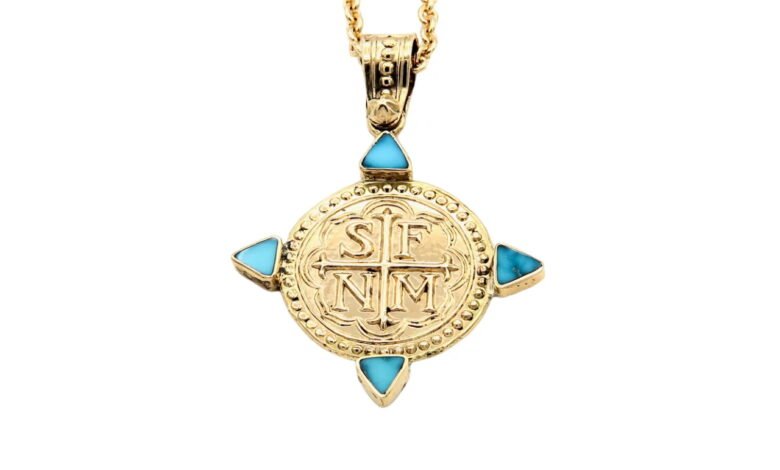
The Cerrillos turquoise Magnus sources is a study in rarity. Its intense, clear blue coloration and distinctive matrix set it apart from other turquoise varieties, and the stone’s historical weight adds an additional dimension that goes well beyond aesthetics. When a collector acquires a Magnus work set with Cerrillos turquoise, they hold something that connects them to a thousand years of human craft, ambition, and meaning.
Source link