The Philosophical Foundation
Tony’s artist statement centers on a crucial decision: “I feel my work is an homage to the equine spirit and to the archetypal role they play in our lives. This is why I always photograph them without riders, saddles, bits, bridles, or any other device that would interfere with their pure essence.”
This commitment distinguishes his work from most equine photography. No riders means no performance, no demonstration of training, no human control. The horses appear as themselves, free from the equipment and contexts that usually define them in relationship to humans. The images focus on essential equine qualities: presence, power, grace, curiosity, wildness contained but not conquered.
The decision carries artistic and philosophical implications. Artistically, removing riders and tack simplifies compositions, focusing attention on horse form, movement, and expression. Philosophically, it positions horses as subjects worthy of attention independent of their utility to humans. The work celebrates what horses are rather than what they do for us.
This approach resonates with contemporary interest in animal consciousness, rights, and authentic relationships rather than mere utility. Tony’s photographs invite viewers to see horses as fellow beings rather than tools or property.
The Visual Language
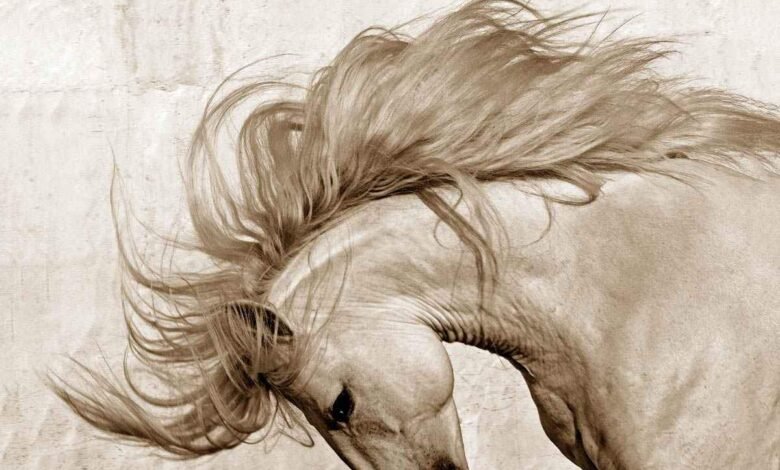
Tony’s photographs demonstrate sophisticated technical control deployed in the service of emotional truth. His backgrounds are carefully considered, often atmospheric, and frequently minimal. Light sculpts form while suggesting mood. The horses emerge from or dissolve into carefully controlled negative space.
Works like “In a Dream,” “Pyrenees,” and “Thunder” showcase his signature approach. The horses appear partially revealed, often in motion, always conveying specific emotional qualities. The images feel like encounters rather than portraits, moments of connection rather than documentation.
His use of black and white or subtle tonalities emphasizes form and gesture over surface color. A white horse against a dark background becomes pure light and movement. A dark horse partially visible through mist or shadow suggests mystery and wildness. The technical choices consistently support emotional content.
The titles contribute significantly. “Spirit Horse,” “Luminous,” “Grace,” “Soul of Portugal,” and “Wild at Heart” position the images as investigations of equine essence rather than mere depictions. The names suggest the qualities Tony sees and attempts to capture: the spirit animating the physical form, the individual character of each horse, the emotional atmosphere of specific moments.
The Book Projects
Tony has published four major books, each exploring different aspects of equine photography and the human-horse relationship. These aren’t simply collections of images but sustained investigations of specific themes and approaches.
Horses, The Forgotten Horses, Spirit Horses, and Horse Medicine demonstrate his evolution as an artist and his deepening understanding of his subject. The book projects allow extended exploration impossible in single photographs, building a cumulative effect through sequencing and thematic development.
Book publishing also positions Tony within the tradition of fine art photography. Serious photographers create books. The physical object allows sustained engagement, different from gallery viewing. Collectors and libraries acquire photography books as complete artistic statements, recognizing them as significant achievements beyond mere reproduction of existing prints.
His books have garnered attention beyond equine circles, reaching general photography audiences and critics who recognize technical excellence and genuine artistic vision regardless of subject matter.
Source link