
NASA’s Artemis II moon mission astronauts make first-ever ‘ship to ship’ call to ISS
This exchange between the Artemis II crew and astronauts onboard the International Space Station marks the first time a moon mission has called an orbital habitat
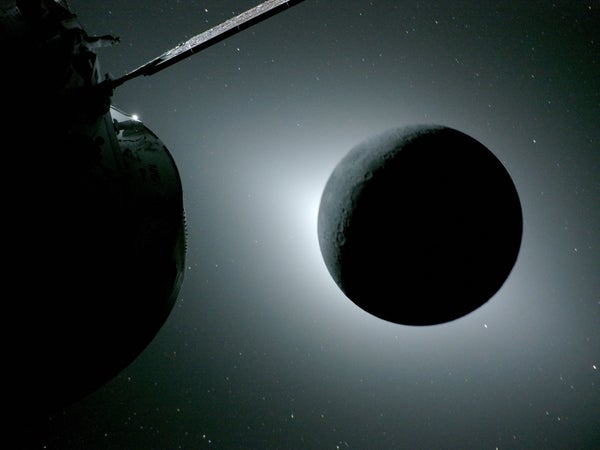
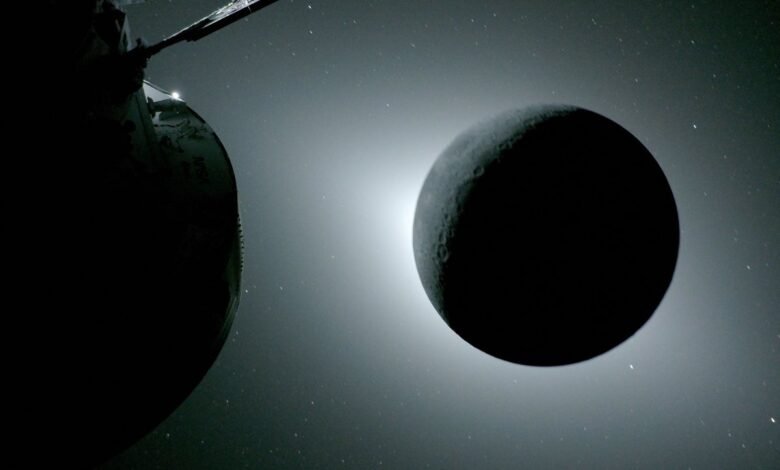
The Artemis II crew’s view of a solar eclipse from the Orion spacecraft.
NASA has launched four astronauts on a pioneering journey around the moon—the Artemis II mission. Follow our coverage here.
NASA’s Artemis II mission made history again on Tuesday when the crew, traveling on their Orion spacecraft, completed the first-ever “ship to ship” call between a human moon mission and the International Space Station (ISS).
The Artemis II crew members—NASA astronauts Reid Wiseman, Victor Glover, and Christina Koch and Canadian Space Agency astronaut Jeremy Hansen—were “all smiles” as they spoke with their nearer-to-Earth colleagues, Wiseman said after the call ended. The Artemis II crew spoke on an approximately 15-minute, audio-only call with ISS NASA astronauts Jessica Meir, Chris Williams, and Jack Hathaway and European Space Agency astronaut Sophie Adenot, trading quips about the good, the bad and the ugly of spaceflight.
“We can tell that you guys are definitely experiencing ‘moon joy.’ I feel like even we are experiencing ‘moon joy’ right now,” Meir told the lunar voyagers, using a term that’s since become something of a catchphrase of the Artemis II mission.
On supporting science journalism
If you’re enjoying this article, consider supporting our award-winning journalism by subscribing. By purchasing a subscription you are helping to ensure the future of impactful stories about the discoveries and ideas shaping our world today.
At the time of the call, the Orion spacecraft, named Integrity by its crew, was more than 200,000 nautical miles from Earth. The ISS orbits about 250 nautical miles above our planet.
Koch, who has worked on the ISS, noted that “basically every single thing that we learned on ISS is up here,” from “the funny and practical—how to eat—[to] how to do silly things with water [to] how to flip around.”
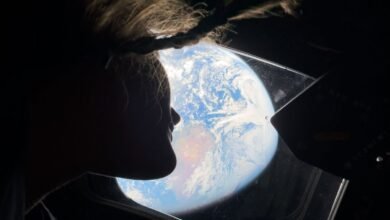
And, she added, while the views on the space station are “awesome,” what stood out to her about looking back at Earth from the moon’s vicinity was how much “blackness” there was around it.
“It truly emphasized how alike we are, how the same thing keeps every single person on planet Earth alive. We evolved on the same planet. We have some shared things about how we love and live that are just universal. The specialness and preciousness of that really is emphasized when you notice how much else there is around it,” Koch said.
She also gave a shout-out to Meir, her “astro sister”: “I always hoped we would be in space again together, but I never thought it would be like this,” Koch said. “It’s amazing.”
It’s Time to Stand Up for Science
If you enjoyed this article, I’d like to ask for your support. Scientific American has served as an advocate for science and industry for 180 years, and right now may be the most critical moment in that two-century history.
I’ve been a Scientific American subscriber since I was 12 years old, and it helped shape the way I look at the world. SciAm always educates and delights me, and inspires a sense of awe for our vast, beautiful universe. I hope it does that for you, too.
If you subscribe to Scientific American, you help ensure that our coverage is centered on meaningful research and discovery; that we have the resources to report on the decisions that threaten labs across the U.S.; and that we support both budding and working scientists at a time when the value of science itself too often goes unrecognized.
In return, you get essential news, captivating podcasts, brilliant infographics, can’t-miss newsletters, must-watch videos, challenging games, and the science world’s best writing and reporting. You can even gift someone a subscription.
There has never been a more important time for us to stand up and show why science matters. I hope you’ll support us in that mission.
Source link