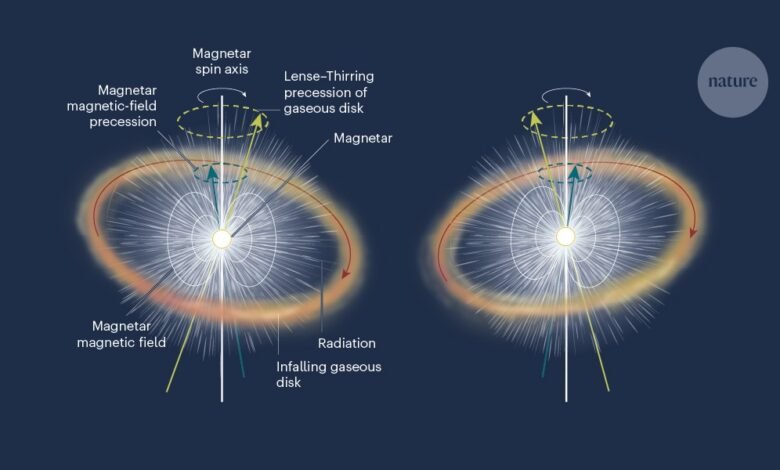
Oscillations in the brightness of a ‘superluminous’ supernova reveal it to be powered by a magnetized neutron star that distorts the orbit of surrounding gas.
Adam Ingram is in the School of Mathematics, Statistics and Physics, Newcastle University, Newcastle upon Tyne NE1 7RU, UK.
When a star reaches the end of its life, it sometimes goes out with a bang: an explosion, called a supernova, that is brighter than a billion Suns. The outer layers of the star are violently thrown into space and the core collapses into an incredibly dense ‘compact object’: either a neutron star or a black hole. The explosion first brightens rapidly, before gradually fading as the ejected layers expand and cool. Over the past 20 years, astronomers have catalogued a population of unusually bright — or superluminous — supernovae1. However, the extra energy source required for this brightness has not been clear. Writing in Nature, Farah et al.2 report observations of a superluminous supernova called 2024afav, which was detected using telescopes around the world almost continuously for six months. The authors uncovered fluctuations in the brightness of the supernova, which indicate that it is powered by a highly magnetized, rapidly spinning compact star called a magnetar.
Access options
Access Nature and 54 other Nature Portfolio journals
Get Nature+, our best-value online-access subscription
$32.99 / 30 days
cancel any time
Subscribe to this journal
Receive 51 print issues and online access
$199.00 per year
only $3.90 per issue
Rent or buy this article
Prices vary by article type
from$1.95
to$39.95
Prices may be subject to local taxes which are calculated during checkout