Company Name: Heatbit
Founder: Alex Busarov
Date Founded: April 2020
Location of Headquarters: Remote
Number of Employees: 25
Website: https://heatbit.com/
Public or Private? Private
In early 2020, Alex Busarov was stuck in his Shanghai apartment during COVID. To quell his boredom, he ordered an Antminer S9, a Bitcoin mining machine, to toy around with.
After plugging it in, he quickly learned two things: Bitcoin miners are noisy and they run hot.
While Busarov saw the prior byproduct as an annoyance, he viewed the latter as an opportunity.
Fast-forward to the present day and Busarov and his team are preparing holiday shipments of bitcoin miners that run quietly and double as space heaters (as well as air purifiers) — the flagship product for his company, Heatbit.
What is more, Busarov has created a product that helps to decentralize Bitcoin’s hashrate, which has become dangerously centralized.
“The first kind of value that I saw in this was how to use energy for heating your home and mining Bitcoin at the same time, but then the mission started evolving as I realized the importance of the decentralization of Bitcoin mining,” Busarov told Bitcoin Magazine. “I think we’re enabling the most resilient infrastructure for Bitcoin to run on.”
How Heatbit Devices Work
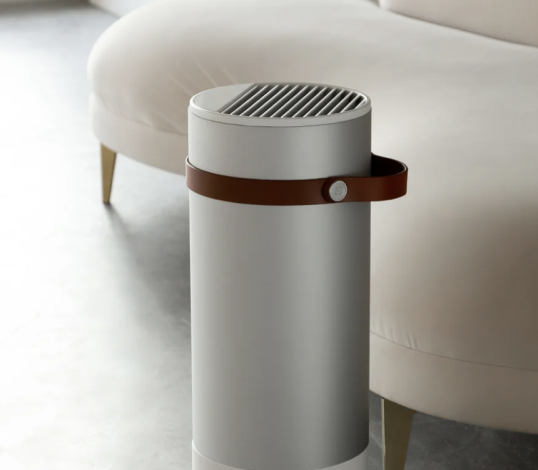
Heatbit devices stand at 24 inches in height and 8 inches in diameter. They’re cylindrical in shape and have a sleek finish.
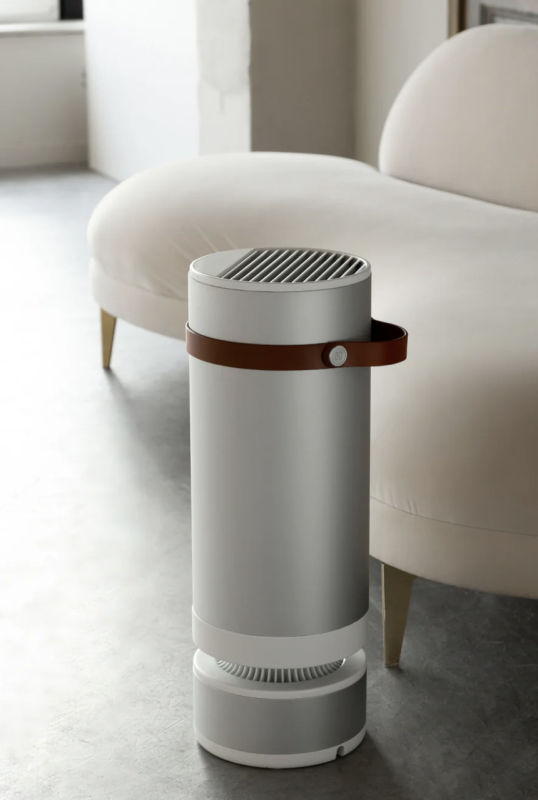
Getting started with a Heatbit device is “as difficult as it is to plug in a Dyson device,” according to Busarov.
After doing so, users need only download the Heatbit app and connect the device to WiFi to begin mining bitcoin.
Once the device is running, using no more energy than a Dyson space heater and making no more noise than a whirring sound at the volume of whisper, it points the hash power that it produces to a default mining pool, which is currently NiceHash and soon to be Luxor. Users will eventually also be able to choose their own mining pool or search for Bitcoin blocks without being part of a pool if they please.
“Basically, you can start without even knowing what a mining pool is,” explained Busarov. “But once you learn a little more or if you already know about mining pools, you just plug in the details for the mining pool you want to join, or solo mine.”
Busarov clarified that the functionality to choose your mining pool or to mine solo hasn’t been enabled for all users yet, but it will be in the near future.
“We don’t have any intention to lock users into a particular pool,” he said.
If the device runs 24/7, it mines approximately 700 sats per day, which equates to approximately 20,000 sats per month — about $20 per month as per bitcoin’s price at the time of writing.
The sats earned are held in a smart contract until the amount reaches a certain threshold (which is currently between $10 and $20 worth of bitcoin) before they’re deposited into the user’s wallet address on the Bitcoin base chain.
Busarov is aware that some users are concerned with Bitcoin fees rising, which is why he and his team are working on implementing Lightning.
“Lightning is definitely coming,” said Busarov. “It’s not enabled yet, but it’s coming.”
Decentralizing The Hashrate
As Busarov mentioned, it wasn’t his original intention in creating Heatbit devices to contribute to the decentralization of the Bitcoin hashrate. However, once he began considering just how centralized it is in some regards, he acknowledged this deeper dimension of Heatbit’s value proposition.
“When you have five big mining companies and 20 well-known mining locations, if you want to damage Bitcoin, you know those 20 locations, right?” cautioned Busarov.
“Also, if the price of Bitcoin goes down a lot, which happens sometimes, and the mining companies are overleveraged, they might not exist anymore,” added Busarov regarding the risk of major mining companies going bankrupt.
“But people will still use the heaters, because they’re not spending any extra money to mine this way. They will still use their miners because they’re not losing any money, which makes it the cheapest way to mine.”
At first thought, Busarov’s claim that the home miners he’s built can play a legitimate role in supporting the Bitcoin network seems a bit hyperbolic, especially considering the fact that the amount of hashrate Heatbit devices currently produce is infinitesimal compared to the amount that major mining companies produce.
However, when one considers the size of the home heater market, Busarov’s assertion seems a bit more believable.
“There’s about 200 million electric heaters being sold every year,” said Busarov, referring to the market Heatbit is looking to capture in the long run.
In the short term, though, Busarov understands that the buyers in that market don’t necessarily have the money for a space heater like a Heatbit, which retails for $799.
“Most people wouldn’t buy an $800 heater,” he explained. “We’re looking into making a more affordable version so that we can sell more.”
Prioritizing affordability has taken a back seat to focusing on quality and timeliness, however. Busarov and his team have been putting all of their efforts into making a durable and dependable device that they can ship with haste.
Built To Last, Ready To Ship
The current iteration of Heatbit devices is the product of a tremendous amount of R&D as well as the sourcing of quality parts from over 70 different suppliers.
In other words, Busarov and his team have built a device that can take a beating. (Not that you should beat your Heatbit device; we don’t condone home Bitcoin miner / home heater abuse here at Bitcoin Magazine.)
“Today, I was doing some testing of the devices for the latest batch,” said Busarov.
“I put one into the box and was literally throwing it around. I was throwing it like UPS or FedEx might, and I took it out to find that it didn’t break,” he added.
Busarov shared this information with a smile, one seemingly half born from my reaction to his account of how he tests the resiliency of his products and half derived from the faith that many in the Bitcoin community have come to have in him.
“When we started building, it was taking longer than expected,” explained Busarov, adding that he and his team were operating under pressure as customers had preordered devices.
“Some people would complain about a delay in shipping and ask for refunds, and we refunded the money, but then a lot of people said, ‘Hey, guys, you’re doing a great thing. We believe in you. Keep going,” he added.
“When people say something like that to you, you can’t stop. When there’s so much faith and trust that people place in you, that gives you so much energy and motivation to keep going.”
Keep going Busarov and his team did, eventually creating a dependable product that’s now ready to ship en masse.
The Future Of Heatbit
Busarov hopes that when major household appliance companies see what Heatbit has created, they become interested in building similar products.
“I think once we show that this is possible, more companies will come to it,” he said.
“It will start getting really interesting when companies like Dyson and Samsung and the major electronics companies start looking into this,” he added.
“Imagine Samsung starts producing home devices — not necessarily space heaters — but other home devices that do mine at scale.”
Busarov has also been keeping an eye on developments in the open source Bitcoin mining movement, and has been in touch with one of its leaders: Skot, the founder of Bitaxe. He’s looking at what he might be able to incorporate from that movement, while staying conscious of the fact that he’s building a consumer product for which safety is paramount.
“I really like the open source Bitcoin mining movement, and I hope we’ll be able to contribute to it,” said Busarov.
“That being said, we need to be careful, because heaters use a lot of power and it can be dangerous for people to just play with them,” he added.
As a final thought, Busarov reiterated that he doesn’t believe he’s simply building an innovative product for the average consumer, but that Heatbit is playing a role in shaping the future of Bitcoin mining.
“Bitcoin mining is not going to be about these huge warehouses using loads of energy and then these big companies having to sell the bitcoin they mine to pay for the energy they use and their operational costs,” he explained. “With home mining, you don’t have to sell any of the bitcoin you earn.”
Source link